Introduction
Why This Question Comes Up Too Late
When do you actually know that your dog has a behaviour problem?
It sounds like a simple question, but most owners don’t ask it early enough. And when they do, it’s often because something has already started to feel difficult—walks are stressful, visitors are unpredictable, or everyday situations require more effort than they should.
For many people, the shift happens gradually. What starts as something minor slowly becomes part of normal life. You adjust without really noticing it. You change where you walk, how you manage your dog, or what situations you avoid.
Others feel it more clearly. There’s a sense that something isn’t right, but it’s hard to define exactly what the problem is or how serious it might be.
That uncertainty is where most people get stuck.
Because the truth is, behaviour problems rarely appear all at once. They build over time, often in subtle ways, until they begin to affect how you live with your dog.
This is where clarity matters.
Not so you can label your dog as “good” or “bad,” but so you can understand what’s actually going on—and whether it’s something that needs to be addressed.

The Two Ways Most Owners Experience This
Drifting Into a Problem Without Realising It
Most dog owners don’t wake up one day and suddenly decide their dog has a behaviour problem.
Instead, they drift into one of two positions without realising it.
The first is quiet and easy to miss. Your dog’s behaviour becomes part of the background. It’s not ideal, but it’s manageable. You tell yourself it’s just their personality, or something they’ll grow out of. Over time, what once stood out stops feeling like an issue at all.
Knowing Something’s Wrong, But Not Acting
The second is more obvious, but just as common. You can see that something isn’t right. Walks feel tense. Certain situations are avoided. You might even feel embarrassed or frustrated at times. But despite recognising it, nothing changes.
Not because you don’t care, but because taking action isn’t always straightforward.
There’s conflicting advice everywhere. Some of it sounds simple, some of it sounds extreme, and a lot of it doesn’t seem to match your dog. Add in time, cost, and uncertainty, and it’s easy to put things off.
So instead, you manage.
You work around behaviours rather than improving them. You adjust your routine to reduce friction. You find ways to cope.
Where Both Paths Lead
Both of these paths lead to the same outcome.
Behaviour that continues without clear direction.
And the longer that goes on, the harder it becomes to change.

Category One: “This Is Just How My Dog Is”
When Behaviour Becomes Normal
This is by far the most common scenario.
Your dog pulls on the lead. It reacts to other dogs. It jumps on guests or struggles to settle at home. None of it feels ideal, but it doesn’t feel serious enough to take action.
So it becomes part of everyday life.
You adjust without really thinking about it. Walks are planned around quieter streets. Visitors are managed carefully. You stay alert in situations where you’re not quite sure how your dog will respond.
Over time, what once stood out starts to feel normal.
That’s where people get stuck.
Because once a behaviour becomes familiar, it’s easy to stop questioning it. It no longer feels like something that needs to be addressed—it just feels like part of who the dog is.
Adapting Your Life Around Your Dog
Most owners in this position don’t realise how much they’ve adjusted.
You might avoid certain walking routes because you know there will be other dogs. You might keep distance from people on walks to prevent reactions. You might hesitate before inviting guests over, knowing your dog will struggle to stay calm.
Individually, these decisions seem small.
But over time, they shape how you live.
Walks become less enjoyable. Social situations require more effort. There’s a constant layer of awareness running in the background—watching, anticipating, managing.
It’s not always obvious stress, but it’s there.
And that’s often the first real signal that something isn’t quite right.
The Gap Between “Trained” and “Balanced”
A lot of dogs in this category have some level of obedience.
They can sit. They can lie down. They might even respond well in controlled environments.
But those behaviours don’t always carry over into real life.
Outside, when there are distractions, movement, or unpredictability, the dog behaves very differently. Commands are ignored, focus disappears, and behaviour feels inconsistent.
This is where the gap becomes clear.
Obedience is about what a dog can do when asked.
Balance is about how a dog exists without needing to be constantly managed.
If a dog can perform commands but still struggles to stay calm, neutral, or settled in everyday situations, there’s something deeper going on.
Category Two: “I Know There’s a Problem, But…”
Why People Wait
The second category is different.
Here, you can see that something isn’t right.
Maybe your dog reacts on walks, barks excessively, or feels unpredictable in certain situations. There’s a level of tension that wasn’t there before. You start thinking about your dog’s behaviour more often, and not always in a positive way.
But despite recognising it, nothing changes.
Not because you don’t care. In most cases, it’s the opposite. You care enough to notice, but not enough clarity to know what to do next.
There’s no shortage of advice. Some of it sounds simple. Some of it sounds extreme. A lot of it contradicts itself. One person tells you to ignore the behaviour, another tells you to correct it, and another suggests you just need to “give it time.”
So you pause.
You tell yourself you’ll deal with it later, when things settle down, when you have more time, or when the behaviour becomes clearer.
In the meantime, you manage.
You avoid certain situations. You control the environment as much as possible. You try to prevent the behaviour from happening rather than addressing why it’s happening in the first place.
And for a while, that feels like enough.
Why Behaviour Problems Don’t Stay the Same
The challenge is that behaviour doesn’t stay still.
Dogs learn through repetition. Every time a behaviour happens, it becomes more familiar. The dog gets better at it, faster to react, more confident in repeating it.
What starts as something mild rarely stays that way.
A dog that pulls lightly on the lead begins to pull with more intensity.
A dog that shows interest in other dogs begins to fixate, then react.
A dog that barks occasionally begins to bark as a default response.
These changes don’t happen overnight. They build gradually, which is why they’re easy to miss.
From the outside, it can feel like things suddenly got worse.
But in reality, the behaviour has been reinforced over time, layer by layer, until it reaches a point where it’s harder to ignore.
This is where people often feel like things have gone too far.
The Window Most People Miss
There’s a period in every dog’s development where behaviour is easier to influence.
It’s when patterns are still forming. When the dog is still learning how to respond to the world around it. When small adjustments can have a lasting impact.
During this stage, clarity and consistency go a long way. You don’t need to do anything extreme—you just need to guide the dog in the right direction before habits become deeply ingrained.
The difficulty is that this window often passes unnoticed.
If behaviour is mild, it doesn’t feel urgent. If it’s manageable, it doesn’t feel like a priority.
So nothing changes.
And by the time the behaviour becomes obvious, it’s no longer new. It’s established. The dog has had time to practise it repeatedly, and it now feels like part of who they are.
That doesn’t mean it can’t be changed.
But it does mean the process requires more structure, more consistency, and more patience than it would have earlier.
So, How Do You Know If It’s Time to Act?
Common Signs Your Dog Has a Behaviour Problem
Not every unwanted behaviour is a serious issue. Dogs make mistakes, get excited, and go through phases.
But when patterns start to repeat—and especially when they begin to affect your day-to-day life—it’s worth paying closer attention.
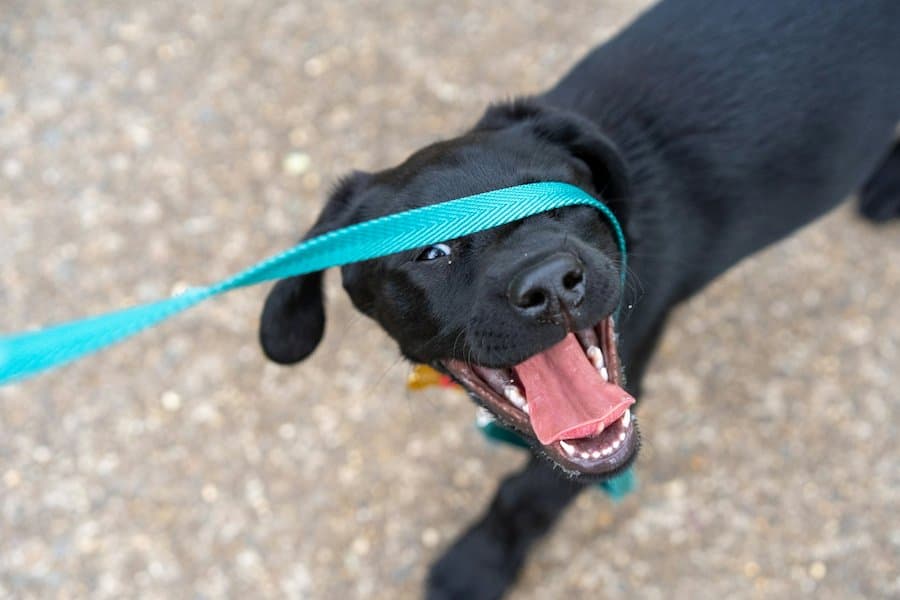
A dog that consistently pulls on the lead, turning walks into something you brace yourself for rather than enjoy, is showing a lack of control and clarity in that environment.
Frequent barking, particularly when it feels automatic or difficult to interrupt, often points to a dog that is overstimulated, frustrated, or unsure how to settle.
Reactivity toward other dogs or people—whether that shows up as lunging, barking, or intense fixation—is usually a sign that the dog is struggling to stay neutral in the presence of triggers.
Jumping on guests or becoming overly excited in social situations can seem harmless at first, but when it’s difficult to control, it reflects a dog that hasn’t learned how to regulate itself.
At home, an inability to relax is often overlooked. A dog that paces, seeks constant stimulation, or struggles to switch off is not fully settled, even in a familiar environment.
And one of the clearest signs is inconsistency. A dog that listens in quiet settings but ignores you as soon as the environment changes is not lacking intelligence—it’s lacking the ability to stay engaged and responsive under pressure.
On their own, these behaviours might not seem serious.
But when they begin to shape how you live—what you avoid, how you feel, how much energy you put into managing your dog—they stop being small issues.
They become something worth addressing.
What Most People Get Wrong About Behaviour
One of the most common misunderstandings is thinking that behaviour problems are simply a lack of obedience.
They’re not.
You can teach a dog to sit, lie down, or stay, and still have a dog that is anxious, reactive, or unable to cope with everyday situations.
Because behaviour isn’t just about what a dog does when asked.
It’s about the dog’s overall state.
A dog that is overstimulated, frustrated, or unclear about what’s expected will express that internally—and that internal pressure shows up externally as behaviour.
That’s what people experience as pulling, barking, reacting, or not listening.
So trying to fix behaviour by adding more commands, without addressing the underlying state, often leads to inconsistent results.
It might work in controlled situations, but it doesn’t hold up in the real world.
Real change happens when the dog gains clarity, structure, and the ability to remain calm and neutral across different environments.
Moving Forward
The goal isn’t to have a perfect dog.
It’s to have a dog you can live with comfortably.
A dog that can move through everyday situations without constant management. A dog that can settle at home, stay composed in public, and respond reliably when it matters.
That starts with recognising where things are at.
If you’ve read through this and seen your own dog in some of these patterns, that’s not something to feel discouraged about.
It’s actually a good place to be.
Because once you can see it clearly, you can start to change it.
The earlier you step in, the simpler the process tends to be. But even if behaviour has been building for a while, progress is always possible with the right approach.
What matters is having a clear understanding of what’s happening, and a plan that actually addresses it.
Because in the end, good behaviour isn’t about control for the sake of it.
It’s about creating a calmer, more predictable life—for both you and your dog.